 Wolfram Alpha has launched. Wolfram has coupled the symbolic and computational math power of their Mathematica software to an extensive collection of curated databases, on topics ranging from chemistry to socioeconomic data to sports statistics.
While the ability to do your high school math homework has some people either very happy or very worried, I’m much more interested in using it to access meaningful data in a way that I could use in a math classroom. A one-step resource for good data coupled with the ability to easily do computations could be fantastic for bringing real-world problems into a math class, or for student-driven projects.
So with that in mind I’ve been poking around at what sort of data and data analysis can be extracted from Alpha. The results are promising, but still a bit clumsy.
Playing around with socioeconomic data seemed promising. But then I tried to ask for the standard deviation of GNP. Alpha completely failed to understand that I meant the set of all GNP data by country, and instead thought I was asking for the SD of a single value for the total world GNP. Is there a way around this?
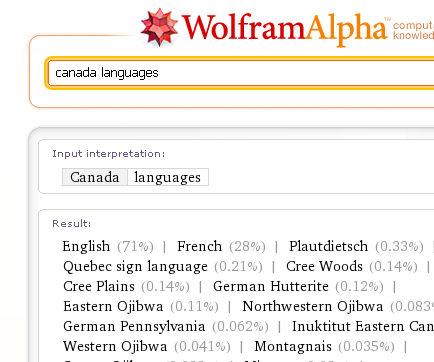
Another weird oddity was looking at the country data for Canada, specifically the results for languages. English and French are obvious enough, but Plautdietsch at third place nationally? I like my vereniki and farmer sausage as much as the next Mennonite-farming-immigrant-descendant, but Stats Canada shows Chinese at third place as of 2001 with 2.9% of the population. In fact, the results seem to miss not only all Asian languages, but all European ones other than English, French, and the oddball Germanic mix.
It looks like a great math tool to have on hand, but with data this rough around the edges it’s hard for me to simply take “Wolfram|Alpha Curated Data” seriously as a primary source just yet.
 josh g.'s notes