Standards-based grading made easy (and less effective)

I’m using standards-based grading (SBG) in my night school Math 12 class right now.  Kind of.  What it amounts to at the moment is that I take the end-of-unit assessment and split it apart into one mark per standard (ie. per skill) rather than a lump-sum grade.

However, SBG is often hailed as a formative assessment tool.  I am doing a lousy job of formative assessment – not completely absent, but not great.  This approach does give students better feedback to use on rewrites, but I don’t particularly have time to adjust my lessons by the time I mark these end-of-unit tests.

The reason I think this is worth sharing is twofold: a) to demonstrate that using SBG is no guarantee that you’re doing things “formatively”; b) to show that SBG has advantages as a form of summative assessment as well as formative.

So what does SBG get me?  For starters, it gives me more fine-grained control over how I weight specific knowledge in the final grade.  If I think that graphing sinusoids should be worth 1/3 of the mark for this unit, I don’t have to pad the assessment with extra questions until I can make the “points” total up to 1/3 of the test.  I can just set the weight on the standard scorecard, and then all I need to care about when writing the test is ensuring that I ask questions that completely demonstrate all of the required skills.

It also makes that grade handed back more meaningful to students.  If they see a 72%, they have to go unpacking what they got wrong, and they may or may not isolate that down to specific skills that they misunderstood.  With the scorecard approach, they can see which stuff they didn’t get at a glance.

It also helps remedy the weird logistics of teaching a night-school class when it comes to test rewrites.  I don’t have office hours or a classroom that you can find me at during lunchtime.  We don’t have time for a full test rewrite during class time.  Breaking the content up into distinct standards means that I can have them re-demonstrate mastery of smaller parts during the 20-30 min we have available at the end of a typical class.

But perhaps the biggest difference it’s made for me is that I’m more confident that the scores I’m assigning to students are grounded in reality.  This is related to having better control over distribution of weights, but it’s more than that.  The SBG approach pushes me to write up a descriptive rubric for what level of ability I would rate as a 2/4, and what’s required beyond that to get a 4/4.  So if I look at that scorecard, I know that someone’s barely-passing grade is aligned with, on average, a barely-good-enough set of understandings and skills, and I can specify exactly why.  In short, I can justify that grade at a glance, to others and (more importantly) to myself.
WCYDWT: Steam user stats, brainstorming and trigonometric modeling

Part of my mandate as a teacher of Principles of Mathematics 12 (ie. roughly Precalc, for you Americans) includes teaching mathematical modeling.  My textbook is filled with little subsections that boldly proclaim, “MODELING!”.  It’s one of the mathematical processes that are supposed to be woven together across all of the curriculum content I’m covering.

I am wrapping up a unit on trig functions and it’s time to hook into the “MODELING REAL-WORLD SITUATIONS” content.  Now, I personally have a serious love-hate relationship with trig functions.  Being a graduate of a computer engineering program means I’ve seen them a LOT in my formal education.  Trig integrals have nearly killed me on multiple occasions.  On the other hand, playing with trig functions in an electronics lab is awesome, and being able to visually comprehend trig graphs is probably the only reason I managed to pass a course on Communication Systems.  So part of me really, really wants them to get this.

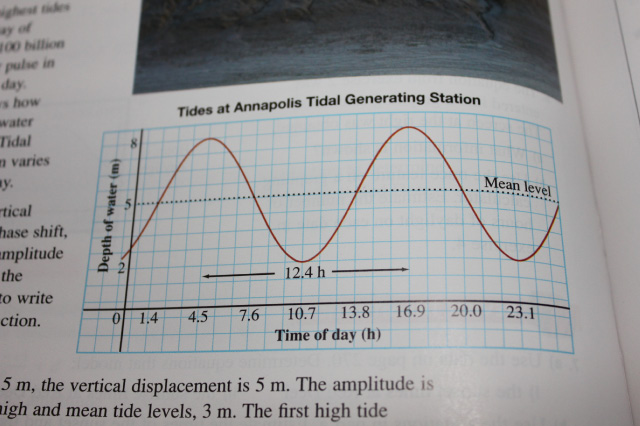
But there’s one big problem: when I look through the textbook for real-world, all I see is textbook perfection.  The opener they use is tide-level data from Nova Scotia – except that they’ve stripped the real data down to this:

completely faked tidal wave graph

This is a complete and utter fabrication.  That sine wave is friggin’ perfect.

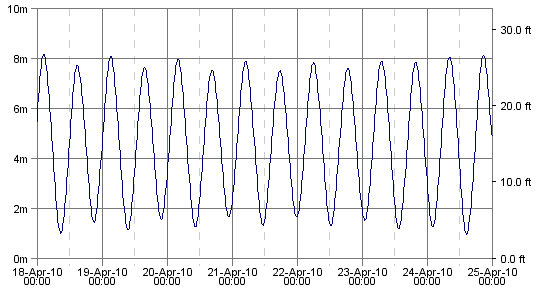
Here’s the reality.

actual tidal levels data from a real source

Messy peaks that don’t always line up.  Some kind of weird alternating pattern hiding in them as well that totally makes sense if you stop for a second and think about how far the earth has turned in 12h.

You know what?  It’s not perfect, it’s reality.  And our model, based on a single sinusoid, is never ever going to match that reality perfectly.  And that’s just fine, but for some reason the textbook seems deathly afraid of letting students realize this.  The really ironic bit is that the real data is already incredibly close to the model, and yet they still couldn’t bring themselves to let students deal with even a tiny bit of messy reality.

So that’s what led me to this.  I’ll just start off by saying this image probably only scores a C on the WCYDWT rubric but somehow this kind of worked anyway.

Steam Users Graph w/ spike in users

(source: Steam Game and Player statistics)

Opening question was an obvious one: “Which part of the graph do you notice first?”

After students pointed out the weird downward spike in the middle, I moused over that part and talked a bit about the numbers and what this was graphing.  (The site this image comes from has that graph in a Flash applet that gives exact values when you mouseover the graph.)  The story went something like this:

This graph shows the number of users connected to the online PC gaming service Steam over the past 48 hours.  That spike in users online probably represents about 500,000 really ticked-off customers who can’t get at their online game.

We can see they got people back online pretty quickly.  Which is good, because you don’t want to give 500,000 ticked-off time to start posting on forums on a Sunday afternoon.  YOU DON’T WANT TO ANGER THE INTERWEBS.

So imagine you’re working at Steam.  It’d be really nice to have some kind of system that alerts you automatically when something like this happens, because you don’t want to be at the office all weekend watching this.

So, ignoring the programming for now and just thinking about the math … how can we come up with a system that catches this?

Brainstorming session ensued!  Ideas – great ideas! – came from the room and hit the whiteboard.  We started off with four big ideas that were just point-form statements:

  • goes down too quickly
  • drops below a threshold
  • below the avg for that time of day
  • doesn’t fit the pattern

This made me so happy.  From there we turned some of these into something we could calculate; we talked about turning these ideas into “math”.  One thing I loved about this brainstorm is that the third item on the list was outside the scope of the class, but at least as good of a solution as what I was guiding them to.

Then we unpacked the big one: “doesn’t fit the pattern”.  What pattern? Can we model it?  Cue discussion / lecture on trig graphing where I showed them how to construct a sinusoidal model, and afterward we checked how accurate it was.  (Not very, but probably enough to fit our task of catching a large drop in user connectivity.)

My own evaluation?  This lesson isn’t a great WCYDWT – it required a lot of me talking, and I had to do some storytelling.  The question wasn’t short.  It got students participating who weren’t normally confident of their skills, but it didn’t get everyone involved.

But I had students asking, nearly begging me at the start of class to wrap up before 7pm to catch the Canucks game.  This lesson went straight through to 7:15 and they didn’t even notice until they were a couple minutes into individual work afterward.  Something must have gone right.

Level design, learning, and assessment

Remember that time you failed?Normally when my brain cross-links game design and education, I try to temper my enthusiasm by remembering that I like to relate nearly everything to games at some point, somehow, and not everyone else has this disease.  But I can’t let this one go.

I’m going to attempt to write about difficulty in game design then talk a bit about the Super Meat Boy design process, namely when it comes to how we approached dealing with difficulty. …

Dealing with difficulty is one of the key challenges I face every time I bring a math lesson into my classroom.  This kind of design analysis gets my attention.

I’ll skip over drawing comparisons to the history of platformer design and the history of mathematics education, but the parallels are there, at least in the caricatured form you hear when teachers gripe.  (“…back before the make-it-fun-and-easy crowd got a hold of the curriculum”, etc)

How could we make a seemingly aggravatingly difficult game into something fun that the player could get lost in?

This is what I can’t let go. This is the question I stare down when I start to question how I’m presenting that next lesson.  This is the question that makes me rethink what I’m doing when I’m writing the next big unit test.

Go, read the article if you haven’t yet.  Then come back.

It’s when I start to look at the solution to the design problem that I suspect Edmund McMillen has it easier than we do in the classroom.

Here are the key points to summarize:

  1. Keep it small.
  2. Keep the action constant.
  3. Reward success.
  4. Extend the challenge as people master the basics.

How many of these could be applied to the classroom to improve things?  Where does it break down?  (I’ve got some ideas but let’s get some discussion going in the comments first.)

Everything is research

From William Gibson‘s blog:

A You write from 10AM til whenever. Is research a separate activity?
Q I don’t regard research as a separate activity. From anything. Everything is research. Relatively little great stuff turns up for me as a result of deliberately looking. Life is crowd-sourcing. In a good way.
A The reason I ask is that research tends to wander off into the weeds so easily, especially on the internets.
Q But they hide the good stuff *in the weeds*!

This is so many kinds of good.  Professional development shouldn’t be limited to seminars and workshops.