Factoring graph puzzles

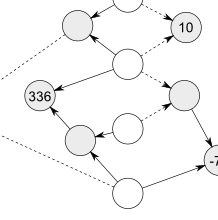
Here’s the let’s-get-thinking warm up opener I used for my first Math 12 class last night.  I shamelessly stole Jason Dyer’s idea and turned it into a three-page set of puzzles.

I handed out the first double-sided page, got them going on that, and when people finished that then I handed them the extra hard follow-up.  I had them sitting in groups, gave everyone their own copy but encouraged them to discuss how to solve them.  By about 40 min, almost everyone had solved the first two sides and some were as far as the last (incredibly evil) puzzle.

Afterwards I showed them a quadratic equation and asked how many people felt comfortable factoring it to solve.  About four hands went up.  The rest of them were surprised when I told them they’d already done it.  I unpacked some of the good stuff going on in there a bit, probably got too wordy and I think I could’ve made the transition from puzzle to algebra better – maybe with a “reveal” puzzle that had more of the usual algebraic notation / structure embedded in it. Anyway, whatever, they were thinking and doing math for over half an hour on the first day of a night class – I call that a win.

Here are the files. The PDF files are ready to print; the .svg files are the source files made in Inkscape.  If you download Inkscape (a free, open-source vector graphics program) you can modify the puzzles and make your own fairly easily.  (Cut-and-paste the circles, and there’s an arrow tool to connect them.)
Creative Commons License
This work is licensed under a Creative Commons Attribution-Noncommercial-Share Alike 2.5 Canada License.

The useless paper vs. computer debate

I just lost 18min of my prep time for Monday watching a Wolfram Alpha researcher give a talk on whether or not using W|A for homework is “cheating”.  The loss was that by the end, the talk had devolved into a false dichotomy of hand calculations vs. computer-based calculations.

I agree that we need to integrate tech like W|A into our classrooms, and more importantly into our assessments.  I also agree that to reach that point, we need to re-evaluate what the goals of hand-calculations are in math curriculum, and probably need to make serious cuts.

The problem of the all-or-nothing is that that kind of thinking has already been abused for years.  Elementary educators who struggle with math anxiety have used the arguments against “rote learning” as an excuse for purely calculator-based arithmetic training.  These students then get passed along and struggle with later work where it’s assumed that you can simply spot common factors because you’re familiar with your multiplication tables.

Does this matter?  Here’s the real problem: any career / lifestyle will carry with it some level of implicitly required mathematical ability in which you don’t want to pull out a computer or even your freaking iPod calculator.  This varies wildly depending on your career, from trades to warehouse work to core math skills as an engineer, but in every lifestyle some amount of rote learning and mental algorithmic skill is irreplaceable.  Math education needs to elevate people’s numeracy to an appropriate level for their life.

This isn’t just an argument for paper-based work; I want to see estimation actually taught well for once.  (Textbooks are inherently horrible at teaching estimation.)

So, don’t pretend this is all-or-nothing.  Admit it’s messy.  Then let’s dive into the real work of figuring out just how much is trash that we need to throw away.

* I’m throwing around big words because it’s quicker, easier, and I have a 1.5-yr-old next to me waiting for me to get off the computer and take him outside.  Sorry.

Night school

The update!  I am not only employed as a teacher-on-call, but I am now hired to teach an evening class of Math 12 through the district’s continuing-ed program.  This means a mostly adult group of students, widely varying levels of ability and recent math experience, and a fantastic opportunity for me to teach an upper-level math course.

It looks like I won’t likely have access to a digital projector or any of that other fancy-shmancy edumacational technology.  So I’m focusing on good ideas for how to manage notes with this group so that we can make the best of the whiteboards.  My wife has taught using a modified Cornell notes technique with some good stuff in there; I think I’d mod it further but there’s something worth stealing from there.  These other bloggers’ ideas are also theft-worthy: samjshah’s binder checks, or Kate Nowak’s homework quizzes.

Mixed in there somewhere is my desire to have downloadable notes in some format.  Bringing camera to snap pictures of whiteboards and uploading, maybe?

Also, follow-up to my official unofficial pro-d, Letters to a Young Mathematician was completely fantastic and I recommend it to any and all math educators.  I was going to blog some specific bits of awesome, but that didn’t happen and now I’ve returned the book and am far too busy prepping for Math 12 next week.  (Did I mention it starts this Monday?)

Yes, my head is spinning around full of a dozen innovative ideas I need to experiment with.  No, I am not going to try them all at once and explode.

Now to dive into the review material and see if I can pull a good collaborative challenge out of there somehow…  This is going to be interesting.

Official Unofficial Pro-D inventory

First, the good news: I’m officially employed as a teacher-on-call.  This is fantastic news but still pretty surreal; the month and a half between practicum and now feels like it’s been an eternity.  But I’m sure that the first day or two of work as a sub will have an extreme “jump into the deep end” effect and I’ll remember how to swim in no time.

Today is a professional development (pro-d) day; for any non-teachers out there, that means a day allocated for teachers to get further training.  A paid day, if you’re a full-time teacher; just a day without work for me.  It has me thinking about the pro-d wishlist I already have stacked up, in the form of books I’ve started reading, books I want to start reading, video tutorials I haven’t finished working through, etc.  So even if I don’t get through any of these today, I thought I’d get my entire pro-d backlog list down and make myself feel like, hey, I’m actually kind of disturbingly ambitious and I should be happy if I even get through a couple of these in the near future!

Books:

  • Elementary Number Theory, Underwood Dudley
    • Started reading / working through; learned about diophantine equations, congruences; lots more good stuff waiting. ps. it’s awesome having a book on your shelf by an author named “Underwood Dudley”. It’s also awesome having a number theory book you got for free, written in the 70’s back when number theory was still an area that was proud for being math-for-math’s-sake with no immediate practical application. (In other words, written before public-key cryptography.)
  • The Colossal Book of Mathematics, Martin Gardner
    • Just grabbed this from the library. It’s a great collection of Gardner’s recreational mathematics topics; I expect I’ll read through some select chunks and then return it. Definitely want to finish reading the bits on topology.
  • Letters to a Young Mathematician, Ian Stewart
    • getting this from the library today

Online pro-d

Long term:

  • Grab my wife’s Abstract Algebra text and learn myself some more maths.
  • Topology: anyone recommend a great textbook or other resource to teach myself this?  I keep loving the recreational bits I’ve seen here and there, but wonder if I’m only seeing an incredibly thin slice of the topic and/or if it’s still as interesting as it sounds if I tackle it more comprehensively.
  • Eventually figure out the category theory -> monads -> functional programming connection that I caught a glimpse of last summer.

(I have this thing where I feel like I need to fill the gaps in my math training, if I’m going to turn myself into an excellent math teacher.  I have a huge applied-math chunk of training via engineering, but I’m pretty weak on proofs and abstract algebras and all of the other upper-level things that aren’t calculus.  I don’t know how far this will last, but I figure it’s a healthy motivation to nurture.  Even if it only gets me a little ways into a number of advanced topics, I’m sure that’ll help.)

Average inspiration

The other day I found the weirdest source of teacher inspiration: reading MLIA (MyLifeIsAverage) over my little sister’s shoulder at my in-laws’ house.

Today, my schedule got switched around so instead of having history 6th hour I have it 2nd. As soon as I walked in I noticed that my teacher didn’t have a brittish accent like he normally does. After having him for nearly half a school year I learned that he went through the day using different accents for each of his classes. Guess who is now officially my new favorite teacher.MLIA

(source)

There was another good teacher one I read that day, but I couldn’t remember how it went so I tried searching “favorite teacher”.  Guess what?  There are so many “new favorite teacher” posts that it’s already a cliché.  People snark about it in the comments regularly.  I find that strangely encouraging – kind of a weird sign that yes, kids really do want to like their teachers.

Anyway, I couldn’t find the other one I had seen, but here are a few more gems.

Continue reading

The job hunt continues

Students and teachers alike are back in classes here today – and I’m at home sorting out what paperwork to do next so that someone hires me.

There aren’t any externally-posted positions for me to apply to right now other than “Teacher-on-Call” (ie. substitute teacher).  I’m feeling strangely ambivalent towards the idea.  The obvious advantages are that you don’t have to take your work home with you as a TOC; no planning, no prep, no marking, no report cards.  This was sounding really, really good by the end of my practicum, but now that I’ve already had a good chunk of time away from lesson / unit planning I’m less certain.

At the hiring panel during my final week on campus, one district HR rep tried to convince us that TOCing is where we should want to be right now – seeing how other teachers do things and learning from their their tricks.  She had a point, but I don’t think snagging people’s “tricks” is going to cut it in the long run.  I’ve barely scratched the surface at planning and implementing the kind of classroom I want to be a part of.  As a TOC, I’m going to be walking into someone else’s room every day, teaching someone else’s lesson.  Until I spend more time wading into the deep stuff, trying to structure challenges for students that keep them hooked in without boring or breaking them, I’m not really getting any closer to mastering this thing.  I’m also not likely to see any lesson plans that push my own boundaries in terms of cooperative learning, student inquiry, WCYDWT / media-driven stuff, etc.

The obvious disadvantage to TOCing is that kids try to get away with murder when there’s a sub.  (At least I know my class did when I was in high school. But they were exceptional; every now and then when students were nuts in my practicum, I’d stop and remember my own grade 9 class and realize that things could be a LOT worse.)  Again, this is good and bad.  The flip side is that this’ll give me experience in an area I’d like to get a better grip on.  I’ve already had a trial-by-fire which has given me a good head start so I don’t feel helpless or hopeless.  The real disadvantage here, hidden beneath the obvious one, is that I’ll get no experience in setting down long-term classroom expectations and building a good learning environment.

So, meh. First things first, though: time to get hired, pay the bills and get access to internal district job postings.  And if I start to feel really stagnant in terms of planning, I can always get my Moodle server running, pick a course and plan something for the heck of it.

More on the Western Canada gatekeeping example

A little more background, this time from the Calgary Herald rather than my second-hand knowledge from email listservs:

University-bound arts or humanities students who once struggled to complete high-school math requirements may find help when a new math curriculum begins for Grade 10 students next year.

Mathematics 20-1, 30-1 and 31 is meant for students who wish to pursue math-intensive subjects while Mathematics 20-2 and 30-2 has been created to prepare students for post secondary studies which would not require higher-level math training.

Arts students, for instance, could learn to interpret statistics and to complete math research projects, assignments which aren’t included in the more science-focused math class where the emphasis would be on calculus.

“It’s not easier math, it’s different content you are studying,” said Henzel.

That last line is the kicker.  This isn’t just a watered-down version of calculus prep, this is a completely different teaching target.

The article ends with a mention that the U of Alberta and U of Calgary will be “aligning” with this curriculum in a few years.  The devil is in the details, though, and they aren’t giving any details yet.  Hopefully they take a more reasonable approach than UBC.

My interview question

My first job interview for a Teacher-On-Call position happened last week, and it went pretty well.  There was only one question that caught me off-guard.

I’ve been looking over your resume and your background.  So why the switch from computer programming to teaching?

In retrospect I don’t know why I didn’t anticipate that one, since I’ve had dozens of people ask me over the last year or two.  It’s not really that surprising a question, but I have a long and messy history with it.

I had one interview for a tutoring position a year and a half ago with a private tutoring service where the woman interviewing me asked me exactly that – except with more confusion and shock.  I gave my answer and she followed up with, “But, you do engineering – engineers make more money than teachers. Why would you be a teacher?”  Which I had just answered, but since my answer didn’t have dollar signs on it she apparently couldn’t understand. I am not even making this stuff up.  I teach math – I’m pretty sure I can add up that this isn’t a quick route to getting rich.

The interviewer I spoke with last week was far more reasonable, but the question is loaded with so much personal stuff that it still made me laugh a bit.  Switching from software engineering to teaching hasn’t been easy.  It took me a while to shed the layers of cultural, peer, and personal expectations around “being an engineer”, even without looking at the dollar signs.  It took even longer to let go of the layers of baggage around being (having been) a video game developer.  If that’s hard to imagine, here’s a quick cross-section: childhood dream job / engineering pride / coder pride / need for vindication after layoff / dream to succeed as an indie dev / need to have creativity recognized / being “the man” and bringing home the big(ger) paycheck.

But when it comes to the original question, my answer can’t be that different than any other sane teacher out there.  I do it because I love learning.  I love watching people get something they didn’t get before.  I like being helpful (although not too helpful).  And working with kids is fun – they have less stuff in the way of getting to know who they are than grown-ups do.  (Yes, even teenagers.)

This is how I like to sum it up:

“Teaching might be nuts, but it certainly isn’t boring.”

Alt: “Making video games for a living was too boring, so I went into teaching instead.”

We, the Gatekeepers

From Dan Meyer‘s report on the “Thoughts On Rationalizing Algebra In Ways That Serve Kids, Not Universities” session from a recent math conference:

The day before CMC-North I was trading notes with our lead counselor, just swapping stories about kids, when she mentioned a student who was at the end of her turn at the local community college. She’d be transferring to a state college to complete a liberal arts degree if it weren’t for a failing grade in Algebra II. Because she can’t yet perform long division on polynomials, she’ll have to postpone her degree in (just guessing here) linguistics a full year.

Stories like this drive me crazy.  Mathematics has been positioned as the primary gatekeeper for post-secondary education.  What’s worse, thanks to early streaming of math education (in the name of helping students achieve success!) that gate is often locked for students the moment they step through the doors of high school.

Now, my problem in writing this is that I so desperately want to hammer out a harsh rant and lay out exactly what’s being done wrong and how to fix it; except that I just finished my practicum with a cross-section of Grade 9’s in both a “Math 9” and “Essentials of Math 9” block.  I know there is no easy solution because I’ve seen at least half a dozen of any category of student you want to think of: underachievers, overachievers, those crippled by poor self-efficacy, students with learning disabilities or global delays, students not actually flagged as LD or delayed but quietly falling behind those who are… the list goes on.  I don’t have a single solution that wouldn’t leave at least half a dozen of those students worse off than they deserve.

But what’s truly frightening is the thought that no amount of educational reform at the secondary level is going to remove that gatekeeper effect.

Western Canada’s provinces and territories are currently adopting a new secondary math curriculum from grades 10 – 12.  This new curriculum has been designed to provide two possible streams leading to post-secondary education.

  • Pre-Calculus prepares students for STEM programs.
  • Foundations is designed to prepare students for liberal arts programs.
  • Applications and Workplace is the “easy” stream, but is notably more challenging than the previous “Essentials” stream. It covers the basic Trig and Geometry knowledge needed for trades work, as well as general life skills math (personal accounting, taxes, etc).

The programs were designed in consultation with post-secondary institutions in Western Canada, and all sounded great.  Then UBC released their basic entrance requirements for students coming to them through this new curriculum:

Either

  • Foundations 11 and 12, or
  • Pre-Calc 11

The effect being, for students who aren’t going into STEM fields and simply want to do enough math to get to their goal, the Foundations stream will mean taking an extra course.  Naturally, many math teachers see that as a death knell for the Foundations stream as it was designed.  (How many English-majors-to-be want to sign up for two math classes when they can get the pain over with more quickly?)

All of this just highlights the real problem: universities and colleges want a gatekeeper.  They want that extra way to filter admissions, because they have to do it somehow.  Worse, they don’t want to be seen as the “easy” school to get into, because this lowers their respectability.  (This also drives me crazy.)  So they demand gatekeepers, whether or not those gateways are actually a more useful math education for their students.