Introduction to Game Design begins

Last night was the first of five classes titled “Introduction to Game Design”.  It was a reasonably good first start, although I’m still adjusting to how to pace the course material.  Hopefully those who attended enjoyed themselves and learned something new.

I hadn’t made proper handout in time, so here are links to the (optional) readings that I assigned.

Common Game Prototyping Pitfalls
How to Prototype a Game in Under 7 Days
Iterative Design
Affordances and Design

We ended the class by playing through a round of GameGame 2.0, a card game that aims to teach players what the core elements of a game design are.  It also makes for an interesting brainstorming tool, as over the course of the game you have to take the cards you’ve collected and translate them into a pitch for a new game concept.  It was pretty successful and the students did a great job of making things up on the spot.  I don’t think GameGame alone does a perfect job at outlining the elements that make up a game design, but it’s close enough that it can be used to augment a more detailed discussion.

A Peek at Valve’s Approach to Game Design

Valve’s Team Fortress 2 team has started an official design blog, opening with a post on the design challenge they’re facing for their next content release pack.

TF2 is a fantastic class-based multiplayer game with great polish and attention to design.   They’ve slowly been releasing content packs focused on upgrades for a specific in-game class, with existing releases for the Medic and Pyro classes which made some great changes without upsetting the game’s balance too much.  What I love about this blog update is that it’s a great example of how to approach a real design problem and how to ask the right questions.

We do design collaboratively at Valve, and one of the side effects of it is that we really need to be able to evaluate design ideas as objectively as possible. Otherwise design meetings would devolve into subjective arguing. We’ve found that the best method of working objectively is to have clear goals up front. Once we’ve got clear goals, we can throw a bunch of ideas up on the board and measure how well each idea achieves those goals.

This is the kind of thought process that I hope to be able to pass along to others when I introduce them to game design.  It’s important to see that the right answer to a design problem isn’t just the one that sounds the coolest in your imagination.  It should solve a specific design problem and fit within constraints that keep the rest of the game from being broken.  That critical thinking process shouldn’t kill the creativity, but should provide constraints which push your creative thinking into new avenues and greater heights until you reach a truly great (and fun!) solution.

For anyone who’s played TF2 enough to understand the game’s classes, the entire blog post is very worth a read.

Prototype post-mortem: Quadrix

(I don’t know if I’m warping terminology by calling this a post-mortem, but since the project is dead it seems appropriate.)

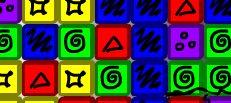
Quadrix thumbnail shotQuadrix is a game concept I came up with last year. It was inspired by Jesper Juul’s writeup on the history of tile-matching games. At the time, I was playing a lot of Planet Puzzle League on the DS as well as digging deeper into the casual games world. Seeing the family tree in Juul’s essay made me reflect on how Tetris has this obscure but substantial place in the history of matching tile games. Despite this, the emphasis on spatial geometry in Tetris hasn’t exactly mapped to tile-matching games, or at least not in the same way. Rather than looking for shapes to fill gaps, the tile-matching player is scanning for colors to bring together. Continue reading

Mysteriously Roguelike Pokémon

So, I have a confession to make. I’ve been playing a Pokémon game.

Okay, that’s kind of a laughable confession seeing as how I’ve “caught ’em all” way back when the original Gameboy game came out. Mock all you want, it was a pretty solid RPG, and the collecting via link-cable trading was a clever way to create a social aspect to the game. (Too bad the money-leeching trading card variety took over; but I digress.)

But! I am not playing Diamond or Pearl, but Pokémon Mystery Dungeon: Blue Rescue Team. Pokémon Mystery Dungeon (PMD) is the latest Western release of the Mystery Dungeon series of games developed by Chunsoft. Mystery Dungeon is a series I learned about last year via GameSetWatch’s @Play series of blog posts about roguelikes. You play the part of a Pokémon yourself, rather than a trainer, and you go off on rescue missions facing up against rogue (*cough* sorry) Pokémon who have been driven wild by strange natural disasters. And yes, this is definitely a roguelike. You can faint from lack of food. Dungeons are randomly generated, everything is turn-based reacting to player actions, and the random number generator can drive you mad (eventually). Continue reading

Omniscient Third-Person Play

I was playing with my grandkids, who, at that time, happened to have that very problem – separating out the fiction of the game from the reality of play. So, we played with only two baby frogs: the “Happy Frog” and the “Sad Frog.”… No one “owned” either of the frogs. We were like gods, cheering for the Happy frog when the Happy frog won. Cheering for the Sad frog when she got to move.

From Bernie DeKoven’s latest blogging. What a fantastic way to skip the heartache of competitive failure! And even better, by attaching personalities to the game pieces instead of relating them to the players themselves, it turns the entire exercise into a little story-making machine. The Happy Frog has fallen behind! Will he still be happy? Is the Sad frog no longer sad? Maybe they’re both happy now and they can be friends!

I wonder if this kind of twist on competitive gameplay can actually reinforce healthy direct competition later on as well. Where by “healthy”, of course I really mean the sort of competition I prefer – where no one takes things too personally, everyone tries their best, and the fun of exploring the game’s strategies and mechanics makes even losing to a well-played game enjoyable. (I’m sure people who prefer to dive headlong into high-stakes, I-will-be-upset-if-I-lose competition think they’re being perfectly healthy too, but they sure do seem to make it harder for me to have fun.) Anyway, maybe teaching kids how to detach themselves from the direct personal connection to winning and losing early on can help that healthy sort of competition to come out later in life.

Audio and slides available from Jon Blow’s presentation

Jonathon Blow has made the full audio and PowerPoint slides from his MGS talk available on his website.  You can grab them here.  He doesn’t think that the news coverage of the presentation is as thorough as I thought it seemed, and recommends listening to the whole thing before trying to judge the merits of his argument.  His presentations are generally good stuff so I’ll recommend it as well; or if you want to wait, it sounds like he might be putting together a video combining the slides and audio.

Jon Blow on how most games today are junk food

“I say this kind of thing, and everybody’s like, ‘whatever dude – you’re smoking something,'” said Blow. “I want to frame this; it’s a matter of scale. What I see as a primary challenge for mankind in this century is to understand and deal with the fact that despite these good enterprises — human rights, safety, leisure time — we do these at such a scale that we cannot help but have them affect the world, as with global warming, ozone holes, pollutants – we haven’t dealt with it yet.”Carrying over the analogy, Blow said, “We don’t intend to harm players but we might be harming them. When tens of millions of people buy our game, we are pumping a mental substance into the mental environment – it’s a public mental health issue – it’s kind of scary, but it’s kind of cool because we have the power to shape humanity.”

Jonathon Blow has talked about this before in a presentation that was made available via interweb video a few months ago. He does a much more complete job of explaining what he’s getting at this time, and this confirms for me that I think he’s on to something. This presentation makes it clearer what he was getting at; mostly it confirmed the way I took what he had said earlier, but I know in discussing this with others they were jumping to conclusions like, “He thinks rewards in games are bad?” which is pretty clearly ruled out this time. The point he’s making isn’t “games are bad”, but “we’re usually missing out on doing things better.”

I think it’s important to point out that this doesn’t seem to be against well-polished games, which is an easy but mistaken conclusion to come to after he uses WoW and Halo 3 as bad examples. Those games are highly accessible and entertaining because they are well-polished, but (in Blow’s explanation) are using reward mechanisms that lack substance (or worse, teach an unhealthy world view: “It doesn’t matter if you’re smart or how adept you are, it’s just how much time you sink in. You don’t need to do anything exceptional, you just need to run the treadmill like everyone else.”).

As far as I can tell, those two things are orthogonal. A game could have more meaningful mechanics and rewards and at the same time do thorough playtesting and design analysis to make sure that the experience of the game flows smoothly for players. He gives Portal as an example of a game that does things well, which I think proves the point.

I hope that a video of the presentation is made available soon. It’d be great to see it in its entirety. In the meantime, the writeup at Gamasutra is pretty thorough.

Getting it

Ian Bogost’s newest Persuasive Games column up on Gamasutra discusses the phenomenon of game industry folk (press especially, it seems) placing the demand on educational or editorial games to “err on the side of more fun” when choosing between fun and educational.

To quote a quote from the column:

There is a maxim I hear frequently in the serious games circles, most recently repeated by Tim Holt in a discussion of the Slate article on Raph Koster’s website. Says Holt:

If you have to make a mistake in the fun versus educational balance, it’s better to be a bit too fun and a bit less educational than the other way around.

It’s a sentiment that seems hard to argue with, if you assume the goal of games is simply education, or fun, or both. If we rephrase this value statement by replacing “educational” with “editorial,” in the case of newsgames for example, it becomes far less persuasive. Education, fun, or other possible experiences might season an editorial game, but who would deny that the latter is its primary goal?


First of all, while I know that both Bogost, Holt and others are generally speaking about which is more prominent in a game design’s mixture of “fun” and “educational / editorial”, it’s hard to respond to this in a way which doesn’t emphasize the this-vs-that nature of the entire discussion. Let me get this out of the way first – fun and educational are not always at odds with each other! There are always design tradeoffs and choices to be made between any number of elements in a game, but let’s not sign up for the “FUN vs. THOUGHT” cage match on next week’s pay-per-view.

That said, what is the role of fun in a primarily educational or editorial game? Not that fun isn’t a self-justifying goal, but it might be worth noting that fun serves a very specific purpose in a teaching or expressive game. Basically, it keeps people playing long enough to get the point. Let’s try expressing that as a nice little theoretical statement:

An expressive game should aim to be fun enough for the player to stay engaged long enough to get the message. (For games which instill player engagement through some means that may not fit your definition of “fun”, substitute “interesting” or “engaging” or what have you.)

Hmm, maybe I should just drop the f-word altogether:

An expressive game should attempt to keep the player engaged in the act of playing at least long enough to get the message.

Hey, now we don’t need to have this “fun” vs “thinking” cage match at all!

So if someone gets bored and quits before they actually receive what you were trying to communicate, then perhaps the game could’ve used some work to make it more engaging. Making it more fun would be the most familiar way to do so.

Of course it’s useful to note that if the point of your game was to communicate that something is incredibly boring and frustrating, then the expressive game doesn’t really need to keep the player around for long. Although I suppose if they want to include a message of drudgery and monotony in there, they could use promised-fun techniques – you know, the ones that keep you playing MMORPGs through the slow grinds. “Keep going, Mr. Kinko’s employee, and maybe someday you’ll be a lvl70 Manager!”

So when someone reviews or critiques an expressive game and faults it for not being fun enough, my question is this: did they get it? If they did, then what obligation is the game under to continue being fun? Or is the real problem that those who review and report on games think themselves obliged to continue playing the game for some arbitrary standard length of time to give a “proper viewpoint” on the game, leading them to continue being bored long after the average player has decided to take what they’ve learned and move on to other fun things?

Keeping co-operation interesting

I received the excellent Lord of the Rings board game this past Christmas, and it’s an interesting experience in co-operative play. (Also, a lot of fun.)

In the game, each player takes the role of one of the hobbits who attempt to bring the One Ring to Mordor to destroy it. You each have individual resources (cards, shields, and other tokens) and can be individually knocked out of the game if the Eye of Sauron reaches you. However, winning is either all or no one, and everyone must work together and strategize collectively to defeat the game. (There is a competitive variation, but it’s mostly just a way to keep individual scores while still working together to win.)

The game is pretty well-balanced, and certainly isn’t a guaranteed win. I’ve only had a chance to play it about six or seven times, but so far it seems that every time I play, the group loses the first play through and then wins the next time if they play again together.

What first drew me to this game (which, yeah, I hinted strongly for at Christmas time) was the idea of co-operative play. There aren’t very many games, board or otherwise, which are both strongly social but non-competitive. While I enjoy competitive game play in general, I tend to be really sensitive to situations where someone who is strongly competitive is taking the game “too seriously” and people are getting tense. I like my games played well, played to win, but taken lightly!

Ironically, playing Lord of the Rings together with friends can still lead to the frustrated tension of losing! There is a significant random element in the game’s progression created through the drawing of shuffled tiles. Roughly half of the tiles are Evil, with varying negative consequences, and the other half are positive tiles. The problem is, drawing an Evil tile of any kind requires that you keep drawing more tiles until you get a good one. This can result in a scenario turning very sour in the span of a single turn, and the chain effect of negative luck leaves you feeling immobilized and sometimes frustrated.

Whether the game is still mathematically balanced or not (and I actually suspect it is), the feeling of losing to a force outside of your control in a highly strategic, time-consuming game can be a bit maddening. I think this, in fact, was intentional – you really do get the sense of being pitted against a truly malevolent force with little chance of success, even if your chances are well balanced.

In fact, I think it’s exactly this sense that the game itself is a difficult and somewhat cruel puzzle that makes it work so well as a co-operative game. The game’s mechanics are fairly complex, with many different resources and movement tracks playing against each other in a way that works well with the game’s story metaphor while also providing layers of strategic elements to sort through. At first, it seems a bit overwhelming; but I think the game would fall flat if it were too straight-forward.

Is complexity required for a co-operative game to achieve a strategic sort of challenging fun? Competitive games can rely on the complexity of the opponent to create challenge within incredibly simple rules (see, for example, Go). But when the opponent is the rules themselves, is it possible for the rules to be both simple and challenging?
Office supplies board games

Okay, so I left that teaser post here over a month ago, and haven’t followed up. Truth is, I’m currently working from home, so actually experimenting with office supplies and getting people to test out a game idea in such an environment is basically impossible.

So I thought, if I’m going to let the idea die, why not let it go out with a plea for help on ye old intertubes? (That is to say, I thought I’d post what I had thought of thus far here, and let anyone who stumbles across it contribute ideas or test things out.)

Idea #1: Spreadsheet Wargame

So my thought here was, board games involve pieces of paper or cardboard with funny squares on them that we move little objects around on, and spreadsheets are papers with funny squares on them. Two plus two equals seven and BAM there’s got to be something funny there!

I had gotten so far as to envision playing a sort of mini-wargame waged over a spreadsheet-defined terrain, using whatever spreadsheets your company happens to make use of, of course, not a custom-designed one. Numbers on the page were to be treated like height maps, with large numbers being tall hills and negative numbers being deadly valleys.

Pros: translates the office data into something entirely different, but meaningful within the newly imagined game context. Plus, you can each use a paper clip as a ‘combatant’ token and go “POW I SHOT YOU” on your lunch break! (Or “ZAP I ZAPPED YOU” if going with, say, a Tron-like sci-fi theme where you are playing the part of digital avatars battling over the rugged data terrain!)

Cons: no one really wants to calculate real line of sight across varying hills and stuff, which probably means drastically simplifying the rules for handling terrain, which means that the spreadsheet itself starts to become less important.

Variation: Maybe the numbers on the page could be some sort of resources that you have to collect, as well as obstacles that affect movement? In this case, maybe the “combat” would amount to stunning or knocking back your opponent, instead of the violent theme. (Or you could keep the “POW I SHOT YOU”, if that makes you and your office mates laugh.)

Comment, please! Even if you just read this and think, “Hey, that sounds like fun”, that would be incentive for me to actually write up proper rules, which I could post up here and let people experiment with.