Carefully designed frustration

This last couple of months has been all about getting to really see progressive teaching techniques in action, especially in one of my math-education classes.  I’ve finally been getting firsthand experience of a lot of the buzzwords that have caught my attention lately – co-operative groupwork based in problem solving and discovery learning.  Also, a lot of fun and not a lot of listening to someone lecture.

A common thread that’s come up now and then during my education program is this whole idea of keeping students challenged enough that they’re actually thinking, but not so challenged that they hate you and the course.  Sounds awfully familiar if you’ve looked at game design.  The number of different catchphrases and terms I’ve heard to describe this concept is growing: flow, challenge, “don’t help them too much”, or zone of proximal development (I want to snark about that one, but do I blame Voygotsky or whoever translated his work from Russian?).

But I think my new personal favorite came from the prof of the above-mentioned math class:

Comfortably frustrated

Which, as he described it, is when you go “ARG! Okay let me try that again”, instead of “ARG! I HATE THIS I’M LEAVING!”  (paraphrased, but not by much)

Introduction to Game Design begins

Last night was the first of five classes titled “Introduction to Game Design”.  It was a reasonably good first start, although I’m still adjusting to how to pace the course material.  Hopefully those who attended enjoyed themselves and learned something new.

I hadn’t made proper handout in time, so here are links to the (optional) readings that I assigned.

Common Game Prototyping Pitfalls
How to Prototype a Game in Under 7 Days
Iterative Design
Affordances and Design

We ended the class by playing through a round of GameGame 2.0, a card game that aims to teach players what the core elements of a game design are.  It also makes for an interesting brainstorming tool, as over the course of the game you have to take the cards you’ve collected and translate them into a pitch for a new game concept.  It was pretty successful and the students did a great job of making things up on the spot.  I don’t think GameGame alone does a perfect job at outlining the elements that make up a game design, but it’s close enough that it can be used to augment a more detailed discussion.

A Peek at Valve’s Approach to Game Design

Valve’s Team Fortress 2 team has started an official design blog, opening with a post on the design challenge they’re facing for their next content release pack.

TF2 is a fantastic class-based multiplayer game with great polish and attention to design.   They’ve slowly been releasing content packs focused on upgrades for a specific in-game class, with existing releases for the Medic and Pyro classes which made some great changes without upsetting the game’s balance too much.  What I love about this blog update is that it’s a great example of how to approach a real design problem and how to ask the right questions.

We do design collaboratively at Valve, and one of the side effects of it is that we really need to be able to evaluate design ideas as objectively as possible. Otherwise design meetings would devolve into subjective arguing. We’ve found that the best method of working objectively is to have clear goals up front. Once we’ve got clear goals, we can throw a bunch of ideas up on the board and measure how well each idea achieves those goals.

This is the kind of thought process that I hope to be able to pass along to others when I introduce them to game design.  It’s important to see that the right answer to a design problem isn’t just the one that sounds the coolest in your imagination.  It should solve a specific design problem and fit within constraints that keep the rest of the game from being broken.  That critical thinking process shouldn’t kill the creativity, but should provide constraints which push your creative thinking into new avenues and greater heights until you reach a truly great (and fun!) solution.

For anyone who’s played TF2 enough to understand the game’s classes, the entire blog post is very worth a read.

Ideas > Design ?

Just a quick follow-up to my last post. Seems my response stirred up some attention, and in the meantime I’ve done some more thinking and discussing and learned a bit more about what Squidi‘s been up to.

Part of why I wrote up my thoughts was that I’m trying to sort them out. There’s a good chance I’ll be teaching some game design workshops in the fall (not because I’ve mastered it but because teaching is one of the best ways to learn more about something). I want to go into this with a decent perspective of what matters and what doesn’t, and be able to convey that to people who are new at this. I don’t want to stifle creative energy, but I also don’t want people setting themselves up to fail because of unrealistic expectations. Having already seen people come to me with a Great Idea which falls short of reality in horrible ways, I want to know how to help people get off of that train-wreck track as quickly as possible and get to making some awesome.

But this time I let myself get sucked into interweb drama, which is never a good idea. I was wrong in some ways, and more importantly I set myself up as The Voice Of Sanity when I’m still floundering through this process myself. Plus I started off with a wrong idea of where Squidi was coming from when he’s probably got more game industry experience than I do. Oops.

So, minus ten points to me for perpetuating internet angsts and misjudging people. Plus a few points for learning something in the process.

Squidi has posted some follow-up thoughts on the value of ideas, and I think he’s onto something:

The idea sets the boundaries. A bad idea with a good implementation may actually be worse than a great idea with a bad implementation. Everything that you can do, every implementation, every possibility, and every potential is embodied by the idea. In other words, the idea defines the range of quality that is possible.

I think I can agree with that, or at least move in that direction. Personally I would add that real-world experience in testing and building on ideas gives you a greater ability to sort out the good ideas from the bad. But that doesn’t change the fact that starting with a crap idea will probably never give you an awesome game. (Unless it’s B-Game Comp awesome, I guess, but now we’re trapped in an infinite loop of semantics.) I’m pretty sure you could also take an amazing idea and completely trash it with shoddy implementation, so maybe ideas are more like an upper bound, or a mean value of a set of possibilities with a long tail downwards into potential craptasticness. But now I’m drawing too many little graphs in my head and no good can come of that.

Ideas vs Design

Ascii Dreams draws attention to a comment thread discussion following coverage of the Experimental Gameplay Workshop at this year’s GDC. One of the games featured at the workshop, Lost in the Static, was based on an idea explicitly borrowed from a list of 300 game concepts released by indie developer writer Squidi as a creative exercise.

In the discussion, Squidi expresses frustration that a game based on his concept got attention at the GDC, while his proposal to discuss the 300 games list he created was rejected.

So, for example, by virtue of spending two days hacking together a generic platforming game, Lost in the Static is elevated above the original inspiration that spawned it? Is that why it is up there on the stage? Because of the code or because of the gimmick? It’s up there on behalf of sweat, not talent. What message does that send?

Two of the EGW organizers as well as Sean Barrett, the creator of Lost in the Static, respond to Squidi’s complaint. Sean gives very explicit credit to Squidi, as he did at the EGW, but he makes a good case against dismissing his contribution to the game’s design as trivial.

Despite the slightly flamewar-ish nature of the end of the thread, there’s a very foundational lesson to be learned here about game design. Squidi doesn’t seem to get it, but the other (very experienced) developers in discussion with him do their best to bring it to light. The way I’ve tried to explain it over the last few years goes something like this:

Ideas are cheap.

Now, I think I’ve probably undersold the creative process (including my own) by phrasing it that way; I’ve run short on brilliant design ideas in the past and it can take deliberate effort to push oneself creatively when working on a project. So sometimes ideas can be hard despite their cheapness.

But an idea is not a design. I’ve seen this misconception in game design, engineering, and I’m starting to see it in visual design as well. Someone (possibly myself) comes up with an idea which, in their mind, will be fantastic and revolutionize things and probably make them bucketloads of money. All they need is to find someone to implement the details, and success!

The problem is that in game design, as well as in almost any endeavor, the design is quite literally in the details. It’s possible to create both a well-designed fun game and a horribly boring game which both stay faithful to the same original concept. (Adding “It must be fun and awesome!” to the concept description is cheating, in the thought experiment as well as real life.) Like probably everyone else who’s ever played a game, I used to think, “Wouldn’t it be great to be the one who comes up with all the cool ideas, and everyone else can do the hard work? Being a game designer would be great!” The problem is, that doesn’t describe a game designer. (Maybe it describes the type of Executive Producer or Studio CEO who likes to drop by and periodically insist that Feature X be added to the game, but trust me, that doesn’t make you a hero.)

Now, many high-level concepts can sound great on paper but completely fall apart when you try to implement them. This is why engineers shake their heads when someone “invents” a revolutionary new energy storage mechanism which falls apart the moment you do any back-of-the-napkin calculations. Now, this does mean that there are “bad ideas”, so ideas aren’t completely without value. But there are two hurdles to overcome. You may not know an idea is bad until you look at the implementation details, or have enough experience to see them coming. Even if an idea isn’t bad at its core, it still requires good design work to take it from “interesting (or marketable) idea” to “great game design”.

Game design is, like any form of design work, about crafting the details into a coherent experience. The game concept or idea is a target, but there are many ways of getting there and not all of them will succeed. Good design work needs to address many different concerns such as complexity, accessibility, aesthetics, technical limitations, and more – and none of these concerns can be fully answered without specific, hard details.
Prototype post-mortem: Quadrix

(I don’t know if I’m warping terminology by calling this a post-mortem, but since the project is dead it seems appropriate.)

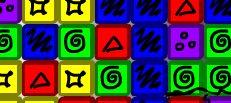
Quadrix thumbnail shotQuadrix is a game concept I came up with last year. It was inspired by Jesper Juul’s writeup on the history of tile-matching games. At the time, I was playing a lot of Planet Puzzle League on the DS as well as digging deeper into the casual games world. Seeing the family tree in Juul’s essay made me reflect on how Tetris has this obscure but substantial place in the history of matching tile games. Despite this, the emphasis on spatial geometry in Tetris hasn’t exactly mapped to tile-matching games, or at least not in the same way. Rather than looking for shapes to fill gaps, the tile-matching player is scanning for colors to bring together. Continue reading

Jon Blow on how most games today are junk food

“I say this kind of thing, and everybody’s like, ‘whatever dude – you’re smoking something,'” said Blow. “I want to frame this; it’s a matter of scale. What I see as a primary challenge for mankind in this century is to understand and deal with the fact that despite these good enterprises — human rights, safety, leisure time — we do these at such a scale that we cannot help but have them affect the world, as with global warming, ozone holes, pollutants – we haven’t dealt with it yet.”Carrying over the analogy, Blow said, “We don’t intend to harm players but we might be harming them. When tens of millions of people buy our game, we are pumping a mental substance into the mental environment – it’s a public mental health issue – it’s kind of scary, but it’s kind of cool because we have the power to shape humanity.”

Jonathon Blow has talked about this before in a presentation that was made available via interweb video a few months ago. He does a much more complete job of explaining what he’s getting at this time, and this confirms for me that I think he’s on to something. This presentation makes it clearer what he was getting at; mostly it confirmed the way I took what he had said earlier, but I know in discussing this with others they were jumping to conclusions like, “He thinks rewards in games are bad?” which is pretty clearly ruled out this time. The point he’s making isn’t “games are bad”, but “we’re usually missing out on doing things better.”

I think it’s important to point out that this doesn’t seem to be against well-polished games, which is an easy but mistaken conclusion to come to after he uses WoW and Halo 3 as bad examples. Those games are highly accessible and entertaining because they are well-polished, but (in Blow’s explanation) are using reward mechanisms that lack substance (or worse, teach an unhealthy world view: “It doesn’t matter if you’re smart or how adept you are, it’s just how much time you sink in. You don’t need to do anything exceptional, you just need to run the treadmill like everyone else.”).

As far as I can tell, those two things are orthogonal. A game could have more meaningful mechanics and rewards and at the same time do thorough playtesting and design analysis to make sure that the experience of the game flows smoothly for players. He gives Portal as an example of a game that does things well, which I think proves the point.

I hope that a video of the presentation is made available soon. It’d be great to see it in its entirety. In the meantime, the writeup at Gamasutra is pretty thorough.

References for my TWU “Digital Games as Communication” Presentation

This post is a collection of links to stuff that I mentioned during my visit at Kevin Schut’s class on Digital Games as Communication. The talk was, roughly, on creative process in the mainstream game industry vs that in independent development, plus a look at what the indie game scene is shaping into today (or at least the parts I’ve found out about so far).  If there’s anything I mentioned that you can’t find here or via Google, or if you have any other questions, drop a comment here or email me at: josh at the domain thoughtlost dot org.  (Does that even fool spambots anymore? I have no idea.)

Linkfest begins after the break.

Continue reading