Here’s a game I came up with last night (with the help of my lovely wife) for subverting the office water cooler into something more interesting.
 Escalating Office-isms: A game for the modern office environment.
Two or more people are required to play Escalating Office-isms. Players should be loitering by a water cooler, next to the copier, or some other suitable location for office small-talk. Waiting in an elevator has the added bonus of giving you a captive audience for your game performance, but the drawback of an artificial time limit (although advanced players will bypass this by simply riding the elevator up and down repeatedly).
The game begins by one player making a casual statement about somebody else in the office, or a fictional character spontaneously written into your office context. The statement must contain at least one name, and at least one “office-ism”, ie. an office buzzword. Buzzword examples are listed later, but the best ones are often those which stand out from your own office experiences.
The next player must make a follow-up statement which includes at least as many office buzzwords as the previous statement played. It must also refer to someone within the office, fictional or otherwise. Fictional names are preferable as it adds a level of misdirection for anyone listening, as well as allowing for more flexibility in play.
Most importantly, the name included in the response must begin with the last letter of the name last spoken in the previous statement. A statement may mention more than one name, but the first proper name used must follow this criteria. Only first names should be used during the game to keep this rule’s difficulty reasonable. If a name has more than one viable spelling, any plausible spelling is allowed to structure the response.
The game progresses with each player in turn responding to the previous statement played as above. In the case of more than two players, players can respond in any order, or spontaneously agree on a clockwise or counterclockwise play order. Players must use non-verbal cues to come to this agreement if they do so at all; the intention being that, while all players are aware of the game’s rules, game play begins spontaneously in the correct context and without any additional clues to others who may be nearby to alert them that a game is being played.
 During game play, all players should maintain a straight-faced, casual but serious tone.
Play ends when players finally give in and go back to work (considered a loss), or when one player keeps a straight face while making a statement that causes other players to crack up laughing (considered a win). Bonus points for all involved if a random passer-by is drawn into the conversation; extra bonus points if the random passer-by is the one who cracks up laughing while all players remain straight-faced. Super intense bonus points if the random passer-by unknowingly responds with a well-formed statement.
An example of a few rounds of play, with office buzzwords in bold:
Player 1: “Were you at this morning’s meeting? I thought John’s action items were highly questionable.”
Player 2: “That is so true! I was just telling Nigel the other day that we need to stay focused on our mission statement.”
Player 1: “We could all learn from Linda’s example. Her action items are so dynamic!”
Player 2: “She needs to work together with Arthur on the project; we need to bring our resources together to maximize our synergy.”
Note that acceptable buzzwords will vary and are subjective. If a player responds in a way which implies a miscount the previous player may repeat his statement, adding emphasis on the words or phrases he considers valid. eg. “I think you misheard me – her action items are very dynamic!” If the responding player still does not seem to agree on the buzzword count, the earlier player should concede to the responding player to allow play to continue as smoothly as possible.
This was inspired by Rules of Play‘s suggested exercise of creating a Site-Specific Resistance game design. If you have fun playing Escalating Office-isms, or have any questions about the rules, I would love to hear from you!
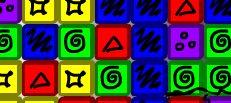 Quadrix is a game concept I came up with last year. It was inspired by Jesper Juul’s writeup on the history of tile-matching games. At the time, I was playing a lot of Planet Puzzle League on the DS as well as digging deeper into the casual games world. Seeing the family tree in Juul’s essay made me reflect on how Tetris has this obscure but substantial place in the history of matching tile games. Despite this, the emphasis on spatial geometry in Tetris hasn’t exactly mapped to tile-matching games, or at least not in the same way. Rather than looking for shapes to fill gaps, the tile-matching player is scanning for colors to bring together. Continue reading
  josh g.'s notes